
Views: 0 Author: Site Editor Publish Time: 2026-04-23 Origin: Site


What happens when wastewater meets the wrong valve? Sludge, grit, fibrous waste, and suspended solids can quickly cause clogging, leakage, and wear. In this article, you will learn why a Knife Gate Valve is often used in sewage treatment, where it performs best, and what to consider before making a selection.
Sewage treatment does not operate under the relatively predictable conditions found in clean-water service. Wastewater streams often carry sludge, grit, organic debris, suspended solids, and stringy fibrous matter that move unevenly through pipelines and process equipment. In many sections of a plant, the medium is not just liquid; it behaves more like a dense, abrasive mixture that can settle, compact, or catch on internal valve surfaces. This makes shut-off far more demanding than in standard utility piping, because the valve must close against material that may resist movement, collect around the seat, or interfere with full sealing. In practice, a valve that performs acceptably in clean service may struggle once exposed to raw sewage, sludge recirculation, or solids-heavy transfer lines.
The challenge begins with the nature of the media itself. Sludge and semi-solid wastewater can contain enough suspended matter to create drag, buildup, and uneven flow patterns, while fibrous waste tends to wrap around internal components or lodge in sealing areas. Abrasive particles such as grit and sediment add another layer of difficulty by wearing down surfaces over time. Under these conditions, shut-off is not simply a matter of stopping liquid movement; it requires the valve to maintain function while exposed to materials that can clog, scrape, or obstruct the closure path.
When a valve is not suited to this environment, the result is usually a combination of performance loss and maintenance pressure rather than one single failure mode.
Failure issue | What typically causes it in wastewater service | Operational impact |
Clogging | Solids, rags, or sludge collect in the flow path or seating area | Restricted movement, difficult shut-off, unplanned cleaning |
Incomplete sealing | Debris prevents full closure or damages the sealing surface | Leakage, poor isolation during maintenance |
Abrasion | Grit and suspended particles wear internal components | Faster deterioration and shorter service life |
Corrosion | Chemically aggressive or contaminated media attack metal surfaces | Reduced reliability and more frequent replacement |
High maintenance frequency | Repeated fouling, wear, and sealing issues | More labor, higher downtime cost, disrupted plant schedules |
In a sewage treatment plant, valves do not serve an isolated mechanical function; they support a continuous process that depends on controlled isolation. Operators need dependable shut-off to inspect pumps, clean lines, service dewatering equipment, and respond quickly during upset conditions or emergency repairs. If a valve cannot isolate properly, maintenance becomes slower, messier, and riskier, and adjacent equipment may have to remain offline longer than planned. For that reason, valve choice is not merely a purchasing detail. It is a reliability decision that directly affects uptime, labor efficiency, and the plant’s ability to keep essential treatment stages running safely.
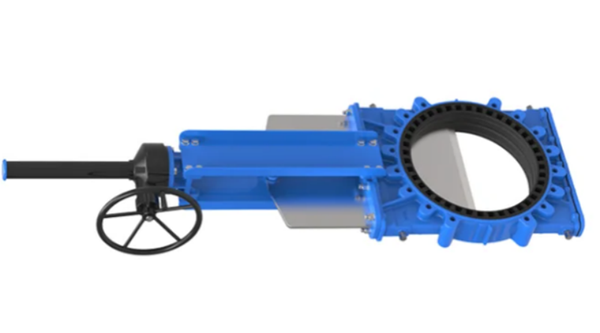
A Knife Gate Valve is widely used in sewage treatment because its design matches the realities of wastewater service more closely than many conventional shut-off valves. In these systems, the valve is rarely handling clean, low-viscosity fluid. It is more often exposed to sludge, rag-containing wastewater, sediment, slurry-like media, and chemically aggressive flow that can interfere with closure or accelerate wear. The value of a knife gate valve lies not in one single feature, but in how several design advantages work together: a cutting gate, a clear flow passage, material flexibility for harsh service, and a compact structure that fits demanding plant layouts. In sewage treatment, these practical benefits translate into better shut-off reliability, lower maintenance burden, and smoother operation in difficult process lines.
The most distinctive feature of a knife gate valve is the sharpened gate edge. During closure, this blade-like gate moves through the media and can cut through sludge deposits, suspended solids, and fibrous matter that might otherwise prevent full shut-off. In wastewater service, this matters because the valve often closes against material that is uneven, stringy, or semi-solid rather than free-flowing liquid. A conventional closure mechanism may trap debris in the seating area, but the knife-edged gate is specifically intended to reduce that problem by pushing through or slicing past obstructive material as it travels downward.
This design improves sealing dependability in dirty-service conditions because the shut-off action is more tolerant of contamination in the line. Instead of requiring a relatively clean path to close properly, the valve is better suited to environments where solids are expected. In practical terms, that means operators are less likely to face persistent leakage caused by trapped debris, incomplete closure caused by fibrous buildup, or repeated manual intervention just to restore proper sealing. In plants where isolation points must perform under heavy solids loading, that ability becomes a major operational advantage rather than a minor mechanical detail.
When fully open, a knife gate valve typically provides a clear, unobstructed bore that allows wastewater and sludge-bearing media to pass through with minimal internal restriction. This full-port flow path is especially important in sewage treatment because it reduces places where solids can accumulate, settle, or snag. The smoother the passage through the valve, the lower the chance that sludge or fibrous waste will remain behind and gradually create a blockage. That is why knife gate valves are especially useful in lines where maintaining open flow is just as important as achieving tight shut-off.
From an operational standpoint, lower restriction can support more stable flow behavior and reduce unnecessary pressure loss across the valve when it is open. That does not simply benefit hydraulic performance; it also helps reduce the likelihood of recurring fouling in process lines that already face solids-handling challenges. In sewage plants, where many pipelines carry media that can thicken, settle, or separate under slow or obstructed movement, keeping the flow path as open as possible is a practical way to reduce maintenance frequency and preserve process continuity.
Sewage treatment exposes valves to a combination of corrosive and abrasive conditions, which is why material selection is a central part of knife gate valve performance. Depending on the application, valves may be manufactured with stainless steel gates, epoxy-coated or otherwise protected ductile iron bodies, and seat materials selected to match chemical compatibility and sealing demands. The purpose of these material choices is not only to resist surface damage, but also to preserve functional reliability over time in media that contain grit, sludge solids, cleaning chemicals, and biologically active contaminants.
Design element | Why it matters in sewage treatment | Typical benefit |
Stainless steel gate | Resists corrosion while maintaining cutting and shut-off performance | More reliable closure in wet, contaminated service |
Coated ductile iron body | Helps protect the valve body from aggressive wastewater exposure | Longer body life and reduced surface degradation |
Suitable seat material | Supports sealing performance under specific chemical and temperature conditions | Better shut-off consistency and lower leakage risk |
Wear-resistant internal surfaces | Handles grit and abrasive particles more effectively | Slower wear and longer maintenance intervals |
Because sewage media can attack metal surfaces while also carrying abrasive particles, a valve that resists only corrosion or only wear may still fail too quickly in service. Knife gate valves are often selected precisely because they can be specified with materials that address both forms of stress at once.
Another important advantage is the compact physical form of many knife gate valve designs. Wastewater plants and pumping stations often have limited installation space, crowded pipe galleries, or retrofit conditions where a bulky valve is difficult to position and maintain. A relatively slim valve body can make installation more manageable in these constrained areas, especially where multiple lines, supports, and actuators are already competing for space.
The construction can also simplify service work. With fewer complex internal flow-control components than some alternative valve types, inspection and maintenance tasks are often more direct. This matters in sewage treatment because downtime carries a process penalty: taking a line or pump section offline may affect multiple connected operations. A valve that is easier to access, easier to isolate, and quicker to return to service helps maintenance teams reduce disruption while keeping the plant’s critical wastewater and sludge-handling systems available.
A Knife Gate Valve delivers the most value in parts of a sewage treatment plant where the flow is dirty, solids-heavy, or difficult to isolate with ordinary shut-off equipment. These are not usually the cleanest or most forgiving sections of the process. They are the points where wastewater carries debris, where sludge becomes dense and slow-moving, and where equipment must be isolated quickly without creating a larger maintenance problem. In these conditions, valve performance is judged by whether it can close reliably, reopen without obstruction, and help operators keep the system under control during routine service or unexpected interruptions.
At the raw sewage inlet, incoming flow may contain rags, organic debris, grit, and suspended solids that can interfere with shut-off if the valve is not designed for contaminated service. Pump isolation points face a similar challenge because they must continue to function even when the media is unstable, debris-laden, or carrying material that settles quickly. A knife gate valve is useful here because these locations require a shut-off device that can tolerate harsh flow conditions while still providing dependable isolation when pumps, upstream channels, or connected equipment need attention.
Isolation at these points supports both maintenance and system control. Operators may need to stop flow to inspect a pump, clean a section of line, or separate one part of the inlet train from another during troubleshooting. Without reliable isolation, even simple service tasks can become longer, dirtier, and more disruptive. In a process area that handles the least conditioned wastewater in the plant, dependable shut-off is a practical necessity rather than a convenience.
The heavy-media side of sewage treatment is where a Knife Gate Valve often proves its value most clearly. Sludge transfer lines, digester feed systems, and biosolids handling sections deal with media that are thicker, more viscous, and more likely to contain concentrated solids than ordinary wastewater flow. These semi-solid process streams can challenge conventional valves by creating buildup in the flow path, obstructing closure, or accelerating wear in the sealing area.
In these applications, the valve must do more than stop liquid; it must isolate a difficult material that may resist movement, settle under low velocity, or compact around internal surfaces. That is why knife gate valves are commonly associated with sludge service. Their design is better aligned with dense, solids-laden flow, making them a practical choice where biosolids movement is part of daily plant operation.
Around dewatering and solid-liquid separation equipment, isolation valves play a process-support role that is easy to overlook until service is required. Filtration units, sedimentation-related equipment, and dewatering systems all need sections of piping or connected devices to be shut off cleanly during cleaning, inspection, or repair. In these areas, a fast and reliable valve helps prevent maintenance from spreading into surrounding equipment or forcing unnecessary downtime across adjacent process stages.
Plant area | Main operating challenge | Why a knife gate valve is useful |
Raw sewage inlet | Debris-heavy incoming flow | Supports shut-off in contaminated service |
Pump isolation points | Need for safe equipment separation | Helps isolate pumps for maintenance and control |
Sludge transfer lines | Thick, solids-rich media | Better suited to dense process streams |
Digester feed and biosolids handling | Semi-solid flow with buildup risk | Improves isolation in heavy-media service |
Dewatering and separation equipment | Frequent service interruptions | Enables cleaner shutdown around equipment |
Selecting a Knife Gate Valve for sewage treatment is not only about choosing a valve type that can handle solids. The better question is whether the valve configuration matches the actual service conditions of the line where it will operate. Wastewater systems vary widely from raw sewage and grit-heavy influent to chemically exposed sludge streams and dewatering discharge. A valve that performs well in one section may be poorly suited to another if the media, pressure, or operating pattern changes. For that reason, selection should begin with the process itself rather than with a standard catalog preference.
The first consideration is the nature of the media. Solids content affects how easily the gate can close and whether debris may collect around the seating area. Abrasiveness matters because grit and suspended particles can accelerate wear on internal surfaces. Chemical exposure influences whether stainless steel, coated ductile iron, or another body and gate material is the better fit. Temperature and pressure also shape the decision, particularly when seat materials must maintain sealing performance under specific operating limits. In sewage treatment, media characteristics should guide both material choice and seat selection, because the wrong combination can shorten service life even if the valve design itself is appropriate.
Sealing direction is another practical choice that should reflect system conditions. Unidirectional valves are often suitable when flow direction is known and consistent, while bidirectional designs may be more appropriate where reverse flow conditions or installation flexibility are expected. The decision affects both performance and installation requirements, so it should be made early rather than treated as a secondary detail.
Actuation should match how often the valve operates and how the plant is controlled. For infrequent operation at accessible points, manual actuation may be sufficient. Pneumatic actuation is often preferred where faster cycling or automated process response is needed, while electric actuation can be useful where remote control and integration with plant control systems are priorities. The right method depends less on preference than on duty frequency, response expectations, and the plant’s level of automation.
Installation conditions have a direct effect on long-term performance. Alignment must be correct so the valve is not forced into service under mechanical stress. Flow direction must be observed where the design requires it. Available space matters not only for fitting the valve body and actuator into the layout, but also for allowing service access once the system is in operation. These details are easy to overlook during specification, yet improper installation can reduce sealing quality, increase wear, and create problems that look like valve failure but actually begin with setup errors.
A Knife Gate Valve is primarily intended for isolation service, not for continuous throttling. That limitation is important in sewage treatment, because operators may be tempted to use one valve for both shut-off and flow control. Prolonged operation in a partially open position can expose the gate and seat to vibration, uneven wear, and increased leakage risk over time. Choosing the valve with its operating limits in mind helps prevent misuse and protects both sealing performance and service life.
Selection factor | Why it matters before purchase |
Media composition | Determines resistance needed against solids, fibers, chemicals, and grit |
Pressure and temperature | Affects body rating and seat suitability |
Sealing direction | Influences installation orientation and shut-off performance |
Actuation type | Should match operating frequency and automation needs |
Installation conditions | Impacts alignment, access, and long-term reliability |
Service duty | Confirms whether the valve will be used correctly for isolation rather than throttling |
A Knife Gate Valve is a strong choice for sewage treatment because it handles difficult media with reliable shut-off, lower clogging risk, and better resistance to wear and corrosion. The best results come from matching the valve to real operating conditions. Wenzhou Kasin Valve Co., Ltd. provides practical valve solutions that support efficiency, durability, and easier maintenance in wastewater systems.
A: A Knife Gate Valve isolates sludge, fibrous waste, and solids-laden flow more reliably than many standard shut-off valves.
A: Yes. A Knife Gate Valve is designed for thick media, including sludge, slurry, and wastewater with suspended solids.
A: No. A Knife Gate Valve is mainly intended for full open or full closed isolation, not continuous flow control.


