
Views: 0 Author: Site Editor Publish Time: 2026-11-27 Origin: Site


Improper fluid handling components in high-purity environments carry massive hidden penalties. A single microscopic crevice leads to batch contamination, extended facility downtime, and failed regulatory audits. Standard industrial plumbing relies on threaded connections and rough interior surfaces. These designs inherently create dead legs—stagnant zones that harbor aggressive bacteria and routinely fail Clean-in-Place (CIP) or Steam-in-Place (SIP) validation. Relying on standard plumbing exposes processing facilities to severe regulatory and financial risks. You need engineering-grade sanitary tube fittings to maintain absolute sterility. These specialized components ensure seamless fluid flow, eliminate microbial harbor points, and meet stringent industry standards like FDA, USDA, and ASME BPE. We see facilities fail inspections simply because they used standard pipe instead of sanitary tube. Upgrading your system prevents these catastrophic failures and ensures your product remains safe for consumer use.
Material Grade Dictates Lifecycle: Choosing between 304 and 316L stainless steel directly impacts corrosion resistance, especially in high-chloride or high-temperature environments.
Surface Finish is Non-Negotiable: A verified roughness average (Ra) and 3A certification are mandatory for sterile processing and effective CIP/SIP cycles.
Connection Types Drive Maintenance Efficiency: The choice between Tri-Clamp, butt-weld, and threaded connections must align with the system's required pressure ratings and the frequency of manual teardowns.
Configuration Impacts Drainage: Selecting the correct fitting shape (e.g., eccentric vs. concentric reducers) is critical for gravity drainage and eliminating pooling.
Supplier Traceability Mitigates Risk: Partnering with a vetted sanitary fittings manufacturer ensures dimensional consistency and provides critical documentation like Material Test Reports (MTRs).
Standard industrial piping focuses on moving high volumes of fluid under pressure without leaking. Hygienic systems operate under a completely different engineering mandate. The primary goal is eliminating dead legs, crevices, and flow interruptions. A dead leg is any branch in a piping system where fluid stagnates. Bacteria thrive in these low-flow areas. Sanitary systems utilize specialized geometries to ensure continuous, turbulent flow that sweeps the internal surfaces clean. When you walk a plant floor, you can spot poor design immediately. A standard threaded tee creates a pocket where fluid sits. Over time, that fluid spoils.
Clean-in-Place (CIP) and Steam-in-Place (SIP) compatibility is another non-negotiable requirement. Processing facilities cannot afford to manually disassemble miles of piping for daily sanitation. Sanitary components are designed to self-drain and withstand high-velocity caustic washes, acid rinses, and high-temperature steam sterilization without requiring manual intervention. Every joint, curve, and valve must allow cleaning fluids to make full contact with the metal. If a fitting has a sharp internal corner, the caustic wash simply flows past it, leaving a biofilm behind.
Baseline regulatory compliance frameworks dictate these sanitary designs. The FDA outlines strict requirements for food and pharmaceutical contact surfaces. The USDA mandates specific cleanability standards for dairy and meat processing. For the highest purity applications, the ASME Bioprocessing Equipment (BPE) standard defines exact dimensions, material chemistries, and surface finishes required to prevent product contamination. Inspectors look for these specific design traits during facility audits.
Tri-Clamp fittings represent the industry standard for modular hygienic piping. The mechanism relies on two flanged ferrules, a specialized elastomeric gasket, and a hinged clamp. When the clamp tightens, it compresses the gasket between the ferrules, creating a perfectly flush internal seam. This design ensures no gaps exist for product to accumulate. You see these on almost every modern food and beverage line.
The primary advantage of Tri-Clamp sanitary pipe fittings is rapid assembly and disassembly. Operators can quickly break down sections of the line for manual inspection, hose replacement, or equipment swapping. However, they carry specific drawbacks. Tri-Clamp joints have lower pressure thresholds compared to permanent welds. They are also susceptible to human error. Over-tightening the clamp forces the rubber gasket into the fluid path. This creates a dam that restricts flow and traps bacteria. Under-tightening leads to leaks during the thermal expansion of a SIP cycle.
Butt-weld fittings create permanent joints via orbital welding. Orbital welding uses an automated machine to rotate an arc 360 degrees around the tube, producing a highly consistent, repeatable weld. The result is a seamless, crevice-free flow path that acts as a single continuous tube. We use these extensively in pharmaceutical water-for-injection (WFI) loops.
Welded systems offer the highest possible pressure ratings and structural integrity. They eliminate the need for gaskets, removing a common point of failure and maintenance. The downside is the intense installation requirement. You need specialized orbital welding expertise, expensive equipment, and precise pipe facing tools. You also have to back-purge the weld with argon gas to prevent sugaring on the inside of the tube. Once installed, the system is highly inflexible. Modifying a welded line requires cutting the tube, purging the lines, and re-welding, which drives up facility downtime.
Bevel seat fittings utilize Acme-threaded unions featuring a beveled metal ferrule and a specialized gasket. Unlike standard NPT threads that taper and bind, Acme threads are broad and flat. They are designed to hold high tension while allowing for repeated assembly.
These fittings provide highly secure connections suitable for legacy dairy systems or high-vibration environments. You often see them specified as brewery pipe fittings where heavy transfer hoses connect to rigid fermentation tanks. The main disadvantage is cleanability. The external threads are inherently harder to wash down, attracting dust and spilled product. Furthermore, stainless steel threads carry a high risk of galling. Galling is a form of cold welding caused by friction. If operators fail to properly lubricate and maintain the connections, the threads will lock together permanently, forcing you to cut the fitting off the line.
Elbows navigate directional changes in the piping matrix, typically at 45-degree and 90-degree angles. In standard plumbing, elbows feature sharp, abrupt turns. In sanitary processing, the design mandate requires standard or long-radius sweeps.
A sweep provides a gradual curve. This minimizes pressure drops across the system and prevents product shear. Shear is a major issue when handling sensitive fluids like dairy proteins, cellular suspensions, or craft beer. Aggressive agitation damages the product structure. Sweeps also ensure CIP fluids maintain high velocity as they navigate corners. High velocity provides the mechanical scrubbing action against the tube walls necessary to remove stubborn residues.
Tees, crosses, and laterals branch fluid paths or integrate instrumentation like pressure gauges and temperature sensors. Designing these intersections requires strict adherence to the L/D rule (Length to Diameter ratio).
The L/D rule dictates that the length of a dead leg must not exceed twice the diameter of the branch tube. If a tee extends too far from the main flow path, CIP fluids cannot penetrate the branch to clean it effectively. Short-outlet tees are engineered specifically to comply with this rule. They keep instrumentation flush with the primary fluid stream and eliminate stagnant zones. When we audit older facilities, long-outlet tees are usually the first things we cut out and replace.
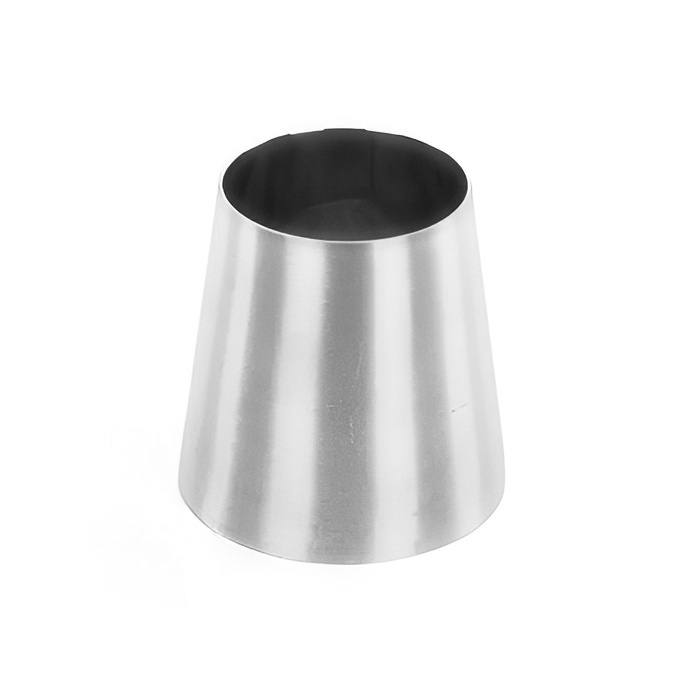
Reducers transition the piping system from a larger diameter to a smaller one. Selecting the wrong reducer guarantees drainage failure. Concentric reducers feature a symmetrical cone shape. The centerlines of both ends align perfectly. You must use concentric reducers strictly for vertical piping runs.
Eccentric reducers have one completely flat side, while the other side tapers. This configuration is mandatory for horizontal piping runs. The flat side must be installed at the bottom, facing the floor. This ensures complete gravity drainage. It prevents pools of product or corrosive cleaning chemicals from sitting in the line after a CIP cycle.
Reducer Type | Shape Profile | Required Orientation | Primary Function |
|---|---|---|---|
Concentric | Symmetrical cone, aligned centerlines | Vertical drops only | Maintains uniform flow velocity in vertical columns. |
Eccentric | One flat side, offset centerlines | Horizontal runs only | Allows complete gravity drainage, prevents pooling. |
Procurement errors happen when engineers misread catalog specifications. Understanding standard nomenclature prevents costly delays on the job site.
Center-to-Face (CTF): This dimension indicates the exact distance from the center of the fitting to the outer edge of the ferrule. It dictates how fittings stack together in tight spaces.
Ferrule Length: Standard ferrules accommodate heavy-duty clamps. Short ferrules save space but require specialized narrow clamps.
Polish Designations: These codes indicate the internal surface finish. A standard #7 finish is different from an electropolished finish.
Alloy Codes: Look for the specific 304 or 316L designation stamped directly on the metal.
The alloy you choose dictates the lifespan of the system. 304 stainless steel serves as the cost-effective baseline for standard dairy, beverage, and low-acid food applications. It offers excellent general corrosion resistance and structural strength. However, it struggles in highly aggressive chemical environments.
For pharmaceutical processing, high-acid foods, or systems utilizing harsh CIP chemicals, 316L stainless steel sanitary fittings are mandatory. The addition of molybdenum gives 316L superior resistance to chloride pitting. Pitting is a common failure mode when the metal is exposed to salt or bleach. The "L" stands for low carbon. Lower carbon content prevents carbide precipitation during orbital welding. Carbide precipitation causes weld decay, which ruins the corrosion resistance of the joint. Using 316L ensures the weld seam remains as durable as the base metal.
Metal components only perform as well as the elastomers sealing them. Gasket selection requires a strict evaluation of operating temperatures and chemical exposure. Using the wrong rubber leads to rapid degradation, leaks, and product contamination. We frequently see facilities use standard EPDM for everything, only to watch the gaskets melt when exposed to high-temperature steam or aggressive oils.
Gasket Material | Temperature Range | Best Applications | Limitations |
|---|---|---|---|
EPDM | -30°F to 300°F | Standard food/beverage, steam resistance, CIP chemicals. | Poor resistance to animal fats and mineral oils. |
PTFE (Teflon) | -100°F to 500°F | Aggressive chemicals, low friction, extreme temperatures. | Inflexible; prone to cold flow; requires high clamp torque. |
Silicone | -80°F to 400°F | High purity, pharmaceuticals, extreme temperature flexibility. | Breaks down under harsh CIP acids and steam cycling. |
Viton (FKM) | -20°F to 400°F | Aggressive acids, essential oils, high-fat processing. | Higher upfront cost; less effective in pure steam applications. |
A critical industry distinction causes massive procurement waste every year. Sanitary systems and standard industrial piping use completely different measurement standards. Sanitary systems are measured by Outside Diameter (OD). Standard industrial pipe is measured by Nominal Pipe Size (NPS).
A 2-inch sanitary tube has an exact outside diameter of 2.000 inches. A 2-inch NPS industrial pipe has an outside diameter of 2.375 inches. They are not compatible. Confusing these two standards leads to catastrophic misalignment on the job site. You cannot weld or clamp an NPS pipe to a sanitary tube without custom-machined adapters. Always verify that your procurement team is ordering true OD sanitary components.
Stated Size | Sanitary Tube Actual OD | Industrial Pipe (NPS) Actual OD |
|---|---|---|
1 Inch | 1.000" | 1.315" |
1.5 Inch | 1.500" | 1.900" |
2 Inch | 2.000" | 2.375" |
3 Inch | 3.000" | 3.500" |
Standard sanitary tube fittings dimensions rely on specific wall thicknesses to maintain flow dynamics and welding integrity. For tube sizes ranging from 1 inch to 3 inches, the industry standard is 16 gauge, which equals a wall thickness of 0.065 inches. Larger diameters step up to 14 gauge (0.083 inches) to handle increased structural loads.
Dimensional consistency is paramount. If the wall thickness varies by even a few thousandths of an inch, orbital welding becomes erratic. The arc will penetrate unevenly, creating internal weld beads or incomplete fusion. These defects disrupt flow dynamics, lower the system's pressure rating, and create microscopic crevices where bacteria colonize. High-quality fittings maintain strict concentricity, ensuring the wall thickness is identical around the entire circumference of the tube.
The 3-A symbol is not a marketing term. It is a rigorous guarantee of hygienic design, fabrication, and cleanability. Formulated by the food and dairy industries, 3-A standards dictate exactly how a component must be built to prevent contamination. This includes mandatory radii on internal corners, specific drainability angles, and the elimination of exposed threads.
To stamp their products with the 3-A logo, a manufacturer must undergo a stringent third-party verification process. An independent evaluator physically inspects the manufacturing facility, reviews engineering drawings, and tests the finished products. Specifying 3A sanitary fittings ensures your system passes USDA and FDA audits without costly retrofits. If an inspector sees the 3-A stamp, they know the component meets the baseline requirements for sterile processing.
Bacteria adhere easily to rough surfaces. To combat this, sanitary components are measured by Roughness Average (Ra), calculated in microinches. A lower Ra number indicates a smoother surface.
Standard mechanical polishing achieves a 32 Ra finish. This is acceptable for most dairy, brewery, and food processing applications. However, high-purity pharmaceutical and biotech applications require much smoother surfaces. These systems demand electropolished finishes of 15 Ra or lower. Electropolishing uses an electrical current and chemical bath to strip away microscopic metal peaks. It leaves a mirror-like finish that resists bacterial adhesion and corrosion. We always specify electropolished fittings for WFI systems and clean steam generators.
Even the highest-quality components fail if installed incorrectly. Gasket extrusion is the most frequent issue in Tri-Clamp systems. When operators use standard wrenches to tighten clamps without torque limits, they crush the gasket. The rubber pushes into the flow path, creating a dam. This restricts fluid velocity and creates a sheltered zone where bacteria survive CIP cycles. Facilities must implement calibrated torque tools for all clamp installations.
Misalignment represents another severe risk. Forcing misaligned tubes together to make a connection induces massive mechanical stress on the joints. This leads to premature gasket wear, micro-leaks, and eventual structural failure during thermal expansion. Piping must be properly supported with sanitary hangers and aligned before any clamps are tightened or welds are struck.
Improper tooling ruins welded systems. Using standard pipe cutters or abrasive saws leaves a beveled, hardened, or contaminated edge. Sanitary orbital welding requires absolute precision. Installers must use dedicated tube facing tools to create a perfectly square, burr-free edge before striking an arc.
Procuring sanitary components requires strict supplier vetting. You must partner with a reliable sanitary fittings manufacturer that prioritizes quality control. The baseline requirement is the mandatory provision of Material Test Reports (MTRs). An MTR documents the exact chemical composition of the steel heat used to forge the fitting. It proves you received true 316L and not a cheaper substitute.
Strict lot traceability is also required. If a component fails in the field, you must be able to trace it back to the specific manufacturing batch. Frame your procurement decision carefully. Balancing upfront unit costs against long-term operational expenses, system downtime, and audit failures is critical. Cheap, unverified fittings inevitably cost more when they trigger a product recall or halt production for emergency repairs.
Audit your current piping matrix to identify and remove any dead legs or improper concentric reducers installed on horizontal runs.
Implement a strict torque-control policy for all Tri-Clamp assemblies to prevent gasket extrusion and flow restriction.
Request comprehensive Material Test Reports (MTRs) and 3-A certificates from your suppliers before issuing any new purchase orders.
Upgrade legacy threaded connections to sanitary butt-welds or Tri-Clamps in areas subjected to heavy CIP chemical exposure.
A: The difference lies in the measurement standard. Sanitary tube is measured by its exact Outside Diameter (OD). A 2-inch sanitary tube is exactly 2.000 inches across. Standard pipe is measured by Nominal Pipe Size (NPS), meaning a 2-inch pipe actually measures 2.375 inches OD. Sanitary tubes also maintain strict, thinner wall thicknesses for cleanability and orbital welding.
A: You must measure the outside diameter of the tube itself, not the flanged end. A common mistake is measuring the wide flange of a Tri-Clamp fitting. For example, a 1.5-inch Tri-Clamp fitting has a flange diameter of nearly 2 inches. Always measure the straight tubular section behind the flange to determine the true fitting size.
A: A concentric reducer is symmetrical, shaped like a uniform cone. It is used strictly for vertical piping drops. An eccentric reducer has one flat side and one tapered side. It is used for horizontal piping runs. The flat side must face down to allow complete gravity drainage and prevent fluids from pooling.
A: No. Material alone does not equal certification. While 304 or 316L stainless steel is required, 3-A certification dictates the physical design. The fitting must have specific internal radii, no exposed threads, and a verified surface finish (Ra). A manufacturer must undergo third-party auditing to legally apply the 3-A symbol.
A: Mixing manufacturers introduces tolerance stacking risks. While 3-A standards provide a baseline, slight variations in ferrule angles, gasket grooves, and wall thicknesses occur between brands. Mixing them can result in stepped internal joints that trap bacteria. It is highly recommended to source critical components from a single, standardized manufacturer.
A: Pressure ratings depend entirely on the clamp style and operating temperature. A standard single-hinge clamp on a 2-inch line might be rated for 150 PSI at ambient temperature. High-pressure bolted clamps can exceed 500 PSI. However, as fluid temperature rises, the pressure rating of the clamp and gasket assembly drops significantly.
A: Replacement timelines depend on CIP chemical exposure and thermal cycling. In high-use brewery environments, standard EPDM gaskets should be inspected monthly and replaced every 3 to 6 months. Thermal shock from alternating hot CIP washes and cold product transfers causes elastomers to lose their memory, leading to leaks.


