
Views: 0 Author: Site Editor Publish Time: 2026-09-10 Origin: Site


Standard isolation valves fail rapidly in high-solid environments. These failures lead to catastrophic line blockages, environmental spills, and expensive unplanned downtime. Plant engineers and facility managers must isolate flow in systems carrying dense, thick, abrasive, viscous, or debris-laden media. They must achieve this without compromising on closure speed, seal integrity, or automation capabilities. Standard gate valves accumulate debris in their bottom tracks. Ball valves suffer severe scoring on their surfaces when closing against abrasive particles. You need a specialized approach to handle these harsh conditions.
The pneumatic knife gate valve serves as the engineered solution for these environments. Its specific mechanical design and automated actuation address the realities of heavy-duty fluid handling. A sharpened blade slices directly through obstructions. Compressed air provides rapid, reliable actuation. This combination guarantees dependable performance where conventional flow control options jam, leak, or fail entirely.
Purpose-Built for Solids: The beveled edge of a knife gate valve is specifically engineered to cut through fibrous debris and heavy sludge, preventing the clogging that plagues standard gate or ball valves.
Automated Reliability: Pneumatic actuation provides rapid, reliable, and fail-safe operation, essential for remote or hazardous locations within treatment plants and mining operations.
Application-Specific Sealing: Selecting the correct seat material—such as specifying a rubber seat knife gate valve for bubble-tight shutoff in wastewater—is critical for long-term performance.
Supplier Vetting is Critical: Partnering with an experienced knife gate valve manufacturer ensures accurate actuator sizing and material compatibility, directly impacting long-term operational expenses.
Establishing the baseline requirements for valves in harsh environments requires understanding the physics of the media. A successful isolation valve must provide zero obstruction to flow when fully open. It must close completely against suspended solids. It also needs exceptional resistance to internal wear. Standard valves force fluid through tortuous paths or rely on cavities where solids inevitably settle. High-solid media demands a full-port design. The valve must get completely out of the way during normal operation to prevent pressure drops and material buildup.
When you deal with heavy slurries, you are fighting specific gravity and settling velocity. If a valve restricts flow even slightly, the velocity drops. When velocity drops, suspended solids fall out of the mixture and pack into the bottom of the pipe. This creates a permanent restriction. Your isolation valves must maintain the exact internal diameter of the adjacent piping.
You must clarify the operational boundaries of these valves. They are specifically optimized for low-pressure, high-density, non-hazardous media. Typical applications include wastewater headworks, mineral slurry transport, paper pulp processing, and fly ash handling. They are not designed for high-pressure hazardous chemicals or volatile gases. Their primary function is handling heavy, abrasive, or fibrous materials at moderate pressures, typically under 150 PSI. Using them outside this scope leads to rapid seal degradation, bent stems, and potential safety hazards on the plant floor.
Mining operations push fluid handling equipment to its absolute limits. Rock slurry, mineral tailings, coal preparation media, and refuse discharge contain highly abrasive particulates. Silica sand and crushed ore act like liquid sandpaper inside the piping system. This high-density media causes rapid erosion of internal valve components. When standard valves attempt to close, abrasive particles get trapped between the sealing surfaces. This prevents the valve from seating properly.
The resulting leak path accelerates erosion through a process known as wire drawing. High-pressure fluid forces its way through the tiny gap, carrying abrasive sand with it. Over time, this high-velocity leak cuts a channel directly through the metal seat, destroying the valve body entirely. A dedicated knife gate valve for slurry combats this through hardened materials and a design that pushes solids out of the sealing area before final closure.
Urban sewage treatment plants face an entirely different set of mechanical threats. Raw sewage, sludge, and biological solids contain high volumes of fibrous materials. Flushable wipes, rags, plastics, and hair create severe operational hurdles at the headworks and primary clarifiers. This specific threat is known as "ragging."
Fibrous debris wraps around internal valve mechanisms, stems, and balls. Once ragging occurs, standard valves cannot isolate the flow. The debris prevents the mechanical components from completing their stroke. Operators are then forced to lock out the system, drain the line, and manually cut the rags out of the valve body. A specialized knife gate valve for wastewater eliminates internal cavities where rags can catch, ensuring reliable operation in biological sludge.
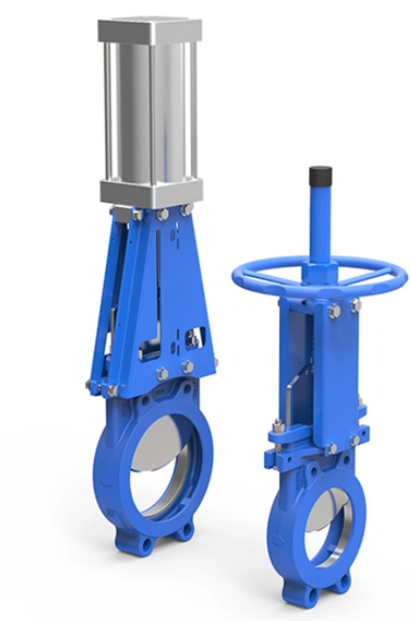
The success of this valve type relies on two primary engineering features. The first is the physical design of the gate itself. The second is the method used to drive that gate through heavy media. Combining a sharpened blade with compressed air creates a system capable of handling extreme fluid conditions that destroy standard butterfly or globe valves.
The mechanics of the gate design separate it from standard gate valves. The bottom edge of the gate features a sharpened, beveled profile. As the valve closes, this beveled edge acts as a guillotine. It physically cuts through fibrous debris, rags, and heavy sludge. The gate pushes through heavy, viscous media rather than trying to compress it.
As it reaches the bottom of its stroke, the bevel clears the seating area. It forces accumulated solids out of the way, ensuring a complete seal against the seat. There is no bottom cavity for debris to pack into. In a standard gate valve, the bottom track fills with grit. When the gate lowers, it hits the grit and stops short of the seat, causing a massive leak. The knife gate design eliminates this failure point entirely.
Pneumatic cylinders offer distinct advantages over manual handwheels and electric actuators. Manual operation is too slow for emergency isolation. Operators cannot spin a handwheel fast enough to stop a major spill. Electric actuators struggle with the high initial torque required to push a blade through dense sludge. If an electric motor stalls against a heavy rag, it can burn out the internal windings.
Pneumatic cylinders deliver instant, high-thrust linear force. They handle high duty cycles without overheating. You calculate the thrust simply by multiplying the available air pressure by the surface area of the internal piston. This allows engineers to size the cylinder to punch through almost any obstruction.
Safety remains a major factor in wet or explosive environments. Pneumatic systems eliminate electrical sparking risks directly at the valve site. This makes them ideal for methane-rich wastewater facilities or dusty mining environments. Furthermore, pneumatic systems allow for simple fail-safe configurations. Spring-return actuators ensure the valve automatically fails open or fails closed during a complete power loss. This mechanical reliability protects the wider piping system from catastrophic overflow or dry-running pumps.
You cannot use a one-size-fits-all approach when specifying these valves. The physical differences between abrasive rock slurry and fibrous wastewater demand different materials, seating mechanisms, and actuator sizing strategies. Putting a wastewater valve in a mining application guarantees failure within weeks.
Material selection dictates the lifespan of the valve. For standard wastewater, cast iron or ductile iron bodies provide sufficient durability. The gate itself should typically be 304 or 316 stainless steel to resist corrosion from biological media and varying pH levels. Highly corrosive industrial wastewater might require specialized alloys like Duplex stainless steel or Hastelloy to prevent pitting and crevice corrosion.
Abrasive slurry applications require a different approach. Standard stainless steel gates will scratch and gall when closing against crushed rock. You must specify hardened gates. Specialized coatings like PTFE reduce friction, while Stellite overlays on the gate edge prevent rapid wear. The valve body in slurry applications often features thicker walls to account for inevitable internal erosion over time.
The seat design determines the allowable leakage rate and the valve's resistance to wear. You must prioritize the correct seat type based on the media.
Metal-to-Metal Seats: You should specify these for slurry applications. Abrasion resistance takes priority over a bubble-tight seal. Metal seats withstand the scouring action of sand and rock. They typically provide Class IV or Class V leakage rates. A small amount of fluid may pass, but the heavy solids are fully contained.
Elastomer Seats: You must specify a rubber seat knife gate valve for wastewater applications. Materials like EPDM, NBR, or Viton provide bi-directional, zero-leakage isolation. Wastewater requires bubble-tight shutoff to allow safe maintenance downstream. However, rubber seats will tear quickly if used in highly abrasive rock slurry.
Polyurethane Seats: For extreme abrasion where some sealing is still required, heavy-duty polyurethane wear rings offer a middle ground. They absorb the impact of rocks better than standard rubber but eventually require replacement.
Specification Feature | Wastewater Applications | Mining & Slurry Applications |
|---|---|---|
Primary Media Threat | Fibrous debris, ragging, biological buildup | High abrasion, silica sand, crushed ore |
Preferred Seat Type | Elastomer (EPDM, NBR, Viton) | Metal-to-Metal or Heavy Polyurethane |
Leakage Standard | Bubble-tight (Zero Leakage) | Class IV or Class V (Acceptable seepage) |
Gate Material Focus | Corrosion resistance (316 SS, Duplex) | Abrasion resistance (Hardened, Stellite coated) |
Body Construction | Ductile Iron or Standard Stainless | Thick-walled Cast Iron or High-Chrome Alloy |
Sizing the pneumatic cylinder incorrectly leads to operational failure. A cylinder that is too small will stall mid-stroke when encountering dense solids. You must calculate the required thrust based on the maximum line pressure and the specific gravity of the media. Always include a safety factor of at least 1.5 to account for media settling or unexpected debris.
You must also evaluate your plant's infrastructure. Standard pneumatic cylinders require a consistent air supply. Verify your compressor capacity, air line routing, and available PSI. Most industrial actuators require between 60 and 80 PSI to generate sufficient downward thrust. Pressure drops in long air lines will severely impact the valve's ability to close through heavy sludge. If your plant air drops to 40 PSI during peak shifts, your valves will fail to isolate the lines.
Selecting the right valve involves weighing initial procurement strategies against long-term maintenance realities. Facility managers must look beyond the initial installation and consider the operational lifecycle of the equipment. Maintenance budgets drain quickly when incorrect valves require constant attention.
Choosing a pneumatic actuated knife gate valve presents specific trade-offs compared to electric alternatives. Pneumatic cylinders generally require lower initial procurement resources. However, they demand an existing, reliable plant air system. If your facility lacks compressed air infrastructure, installing dedicated compressors changes the resource calculation entirely.
Maintenance complexity strongly favors pneumatic systems. Pneumatic cylinders are mechanically simple. Plant technicians can easily rebuild them on-site using basic seal kits. You isolate the air, unbolt the cylinder head, replace the O-rings, and put it back in service within an hour. Electric actuators contain complex motors, circuit boards, and gearing systems. When an electric actuator fails in a wet wastewater environment, it often requires specialized technicians or complete unit replacement. Pneumatic systems tolerate harsh, wet conditions far better than sensitive electronics.
You face a clear choice between off-the-shelf commodity valves and custom-engineered solutions. Sourcing equipment directly from a specialized knife gate valve manufacturer requires more initial planning. However, it drastically reduces long-term maintenance overhead.
Consider the maintenance intervals over a 10-year lifecycle. Commodity valves often require frequent packing gland adjustments to prevent external leaks. Their seats wear out rapidly because they are not specifically matched to the media. A custom-engineered valve features optimized packing materials and exact seat compounds. This extends the time between required maintenance shutdowns. Reducing the frequency of confined-space entry for valve repair justifies the initial engineering effort. Every time you have to build scaffolding to reach a leaking valve, you lose money and risk personnel safety.
Even the best-engineered valve will fail if installed incorrectly or supported by poor infrastructure. You must actively manage implementation risks to ensure reliable flow isolation. Field installation errors account for a massive percentage of premature valve failures.
Moisture, compressor oil, or particulates in the plant air supply present a major risk. These contaminants degrade the internal seals of the pneumatic cylinder. Over time, this leads to sluggish actuation, loss of thrust, or complete cylinder failure. Water in the air lines can also freeze in outdoor installations, locking the actuator completely.
Mitigation: You must require the installation of Filter-Regulator-Lubricator (FRL) units directly upstream of the valve. FRLs strip moisture and dirt from the air while providing necessary lubrication to the cylinder walls. Regular maintenance of these FRL bowls is non-negotiable. For outdoor environments, install desiccant dryers at the compressor to eliminate moisture entirely.
Many standard knife gate valves are unidirectional. Installing them backward against the pressure flow forces the gate away from the seat, causing massive leaks. Furthermore, installing these valves at horizontal angles allows heavy solids to pack into the bonnet or chest area of the valve. This prevents the gate from retracting fully.
Mitigation: Enforce strict adherence to manufacturer flow direction arrows during pipe fitting. If backflow is possible in your system, you must specify bi-directional valves. Avoid horizontal installations in heavy slurry lines. Always install the valve vertically to allow gravity to keep the chest area clear of settling solids. Ensure pipe flanges are perfectly aligned before tightening bolts to prevent placing mechanical stress on the cast valve body.
Sourcing from a generic supply house rather than a specialized pneumatic knife gate valve supplier introduces severe operational risks. Generic suppliers often lack the engineering background to calculate exact thrust requirements. This results in undersized actuators and incompatible elastomer selections.
Mitigation: Establish strict evaluation criteria for your suppliers. Demand flow coefficient (Cv) data for your specific pipe size. Require Material Test Reports (MTRs) to verify metal composition. Ensure the vendor complies with recognized manufacturing standards like MSS SP-81 or AWWA C520. A reliable vendor will ask detailed questions about your media density, line pressure, and operating temperature before quoting a valve.
The pneumatic knife gate valve remains the most reliable, practical isolation solution for systems handling dense solids. Standard valves are inevitably destroyed or jammed by abrasive slurry and fibrous wastewater. By leveraging a sharpened gate and the rapid thrust of compressed air, facilities can maintain flow control in the harshest environments.
Your shortlisting logic must remain application-specific. Prioritize metal seats and hardened gates for abrasive mining slurry. Prioritize rubber seats and corrosion-resistant bodies for municipal wastewater. Always size the pneumatic actuator for the worst-case pressure scenario, including a generous safety factor.
Take the following actionable steps to improve your fluid handling systems:
Audit your current plant air infrastructure to confirm you have consistent pressure (60-80 PSI) at the intended installation site.
Calculate your exact maximum line pressure and the specific gravity of your media before requesting equipment quotes.
Inspect your current failing valves to identify the exact failure mode, such as seat erosion or bent stems, to inform your new specifications.
Consult directly with a verified manufacturer to ensure the actuator sizing and seat materials match your exact operational realities.
A: The primary difference lies in material selection. Slurry valves prioritize abrasion resistance. They utilize hardened metal seats, heavy-duty bodies, and specialized gate coatings to survive crushed rock and sand. Wastewater valves focus on preventing biological corrosion and achieving bubble-tight seals. They typically use stainless steel components and rubber seats to isolate liquids and fibrous matter completely.
A: Compressed air enters a pneumatic cylinder mounted above the valve. This air pressure drives an internal piston either up or down. The piston connects directly to the valve stem and the sharpened gate. This linear force rapidly raises the gate to open the flow or lowers it to slice through media and isolate the line.
A: No. While rubber seats provide excellent, bubble-tight sealing in wastewater, highly abrasive slurry will quickly tear standard elastomers. Silica sand and rock will destroy EPDM or NBR seats in a matter of weeks. For abrasive media, you must specify metal-to-metal seats or highly specialized, replaceable urethane wear rings.
A: Standard industrial pneumatic actuators typically require a clean air supply between 60 to 80 PSI (4 to 5.5 bar). However, the exact pressure requirement depends heavily on the valve size, the media density, and the internal line pressure. Always consult the manufacturer's sizing charts to ensure your plant air can deliver the required thrust.
A: Look for suppliers who offer application-specific engineering rather than just off-the-shelf sales. They should provide transparent actuator sizing calculations and material test reports. A reliable supplier will also guarantee the rapid availability of replacement parts, such as packing glands and seats, and strictly adhere to industry manufacturing standards like MSS SP-81.
A: Standard knife gate valves are designed strictly for on/off isolation. You should never use them to regulate or throttle flow. Throttling creates high-velocity flow across a partially open gate, causing rapid, severe wear on both the gate edge and the seat. If you require throttling, you must specify a specially designed v-port knife gate valve.


